Kusi Ampem Darko · 8+ Years in Practice
Nana Yaw Ananse
Sculptor, Educator, Activist
I was born in Adanwomase, Kumasi, in the Ashanti Region of Ghana — a community where the rhythm of the loom is the heartbeat of daily life. I grew up in a household of weavers: my father, my great-grandfather, my kin. We are custodians of Kente, the sacred woven cloth whose name derives from kenten — "basket" — a vessel that holds memory, identity and spiritual meaning.
Born in Adanwomase, Kumasi, Ghana, Kusi Ampem Darko — known as Nana Yaw Ananse — is a multidisciplinary artist, educator and activist dedicated to harnessing the transformative power of art to promote environmental sustainability, social justice and community empowerment.
With over eight years of professional experience, Ananse's expertise spans sculpture, picture-making, theatre direction and choreography. His artwork has been shown in exhibitions across Ghana and beyond, alongside plays he has directed and choreographed.
He has designed and implemented programs that promote creative expression, environmental awareness and social responsibility — empowering individuals and communities to become active agents of change.
Artist Statement
For too long, Africa has been perceived through the lens of the global West — filtered through media, flattened by colonial narrative, rendered invisible by neocolonial frameworks. These distortions do not merely shape how the world sees us; they shape how we see ourselves. Colonialism did not only take our resources; it took our cosmology. I reject this. My art is a search for what was lost — and what never left.
I began by asking a simple, devastating question: with all we have been told is the "ideal" way to live — through any imported framework that demanded we abandon our African identity — has any of it truly worked? The answer, visible in the degradation around us, was no. So I turned inward, to the etymology of my own tongue. I discovered that in my mother tongue, there is no word for "sustainability." It is an English imposition. But there is Nipadua — the human body, literally "human tree." This is the backbone of my practice.
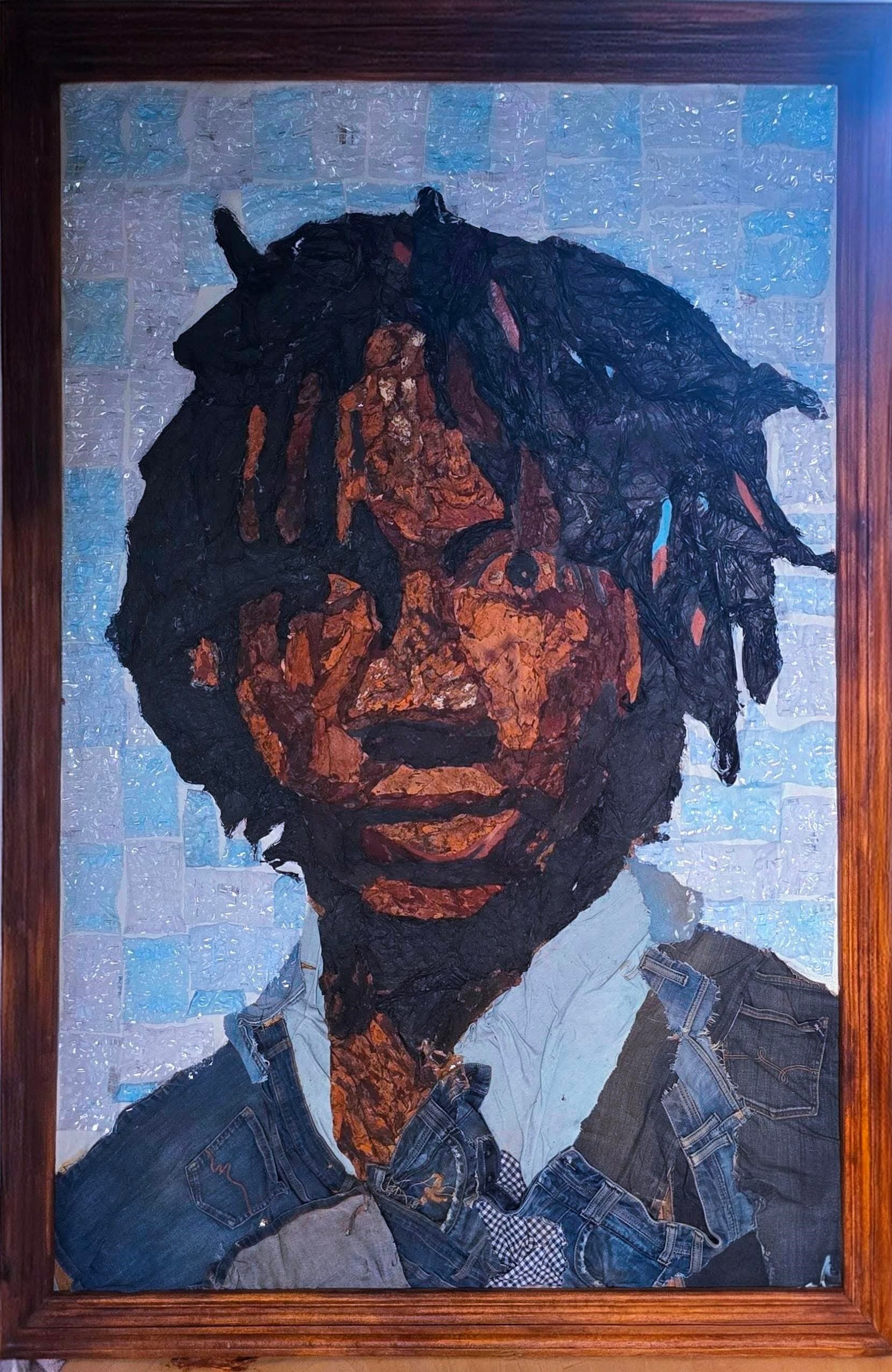
My work begins in cemeteries, where I collect the bark of neem trees — trees that stand witness to decay, to transformation, to reincarnation. I make portraits of fallen trees, seeing in them the metaphors of ancestors who believed that death is merely a change of state. I weave these materials into human forms, asking the viewer to see themselves in the tree, in the rock, in the river. If you would not let a human being die, why would you let a forest burn?
I work with recycled plastics, with discarded objects, with the detritus of a throwaway culture imposed upon us. These materials are not merely "waste" — they are evidence of a broken relationship with the earth, a relationship I am trying to mend, one artwork at a time.
Practice Philosophy
On Nipadua: The Human Tree
Nipadua is not merely a concept; it is a cosmology. In my mother tongue, the human body is called "human tree." We have roots. We have leaves that breathe. We are not separate from nature; we are nature, temporarily arranged into consciousness. The tree is not a metaphor for the human. The human is the tree.
On Creation as Ritual
I do not call my practice multidisciplinary. I call it ritual. When I create, I am circling the object, dropping it, breaking it, stitching it, coiling it — manipulating the energy surrounding the material. This is not preparation for the artwork. This is the artwork. The artist is a vessel; the message is received, channeled and transmitted through the body in action.
On the White Cube and Its Limitations
The white cube asks the viewer to stand still, to look without touching, to consume without participating. But my work is not made for consumption. It is made for encounter. When I exhibit, I seek to transform the space into a site of ritual — the viewer becomes participant, the wall becomes skin, the floor becomes earth.
On Weaving as Worldview
Kente is not cloth. It is language. Each pattern is a proverb, a historical event, a moral teaching, a name. To weave is to compose meaning from thread, to make visible what is otherwise felt. But weaving is also movement — the shuttle flying back and forth is a dance, the beat of the treadle is a drum. To separate the woven cloth from the body that wove it is to sever the work from its soul.
On Materiality and Memory
Every material I use carries memory; nothing is neutral. The bark remembers the tree. The plastic remembers the oil well. The clay remembers Asase Yaa's body. My body remembers my father at the loom. Wood is dua — it was living, it had sunsum (spirit) and kra (soul-force). To cut it without ritual is murder; to burn it without purpose is desecration. I do not take. I receive.
On the Role of the Artist
The artist is not an entertainer. The artist is a custodian of consciousness, a translator between worlds, a vessel. My work is addressed first to my community — to the young weaver in Adanwomase, to the elder who remembers the old ways — and also to the global viewer, not to perform "Africanness" for consumption, but to insist on the universality of indigenous wisdom.
Artistic Vision
My vision is simple and radical: to make art that heals the fracture between African people and their environment, between the self and the cosmos, between the past and the future. I want viewers to leave my work not with answers, but with questions that unsettle them into awareness. What if the tree is my brother? What if every material is alive?
ananse@nanaanansenipadua.orgBack to About