Article · July 2026 · 8 min read
Weaving African Legacy
How Kente became the backbone of a practice rooted in memory, ecology and the refusal to separate the body from the land. A reflection on growing up in Adanwomase — where the loom is the heartbeat of daily life.
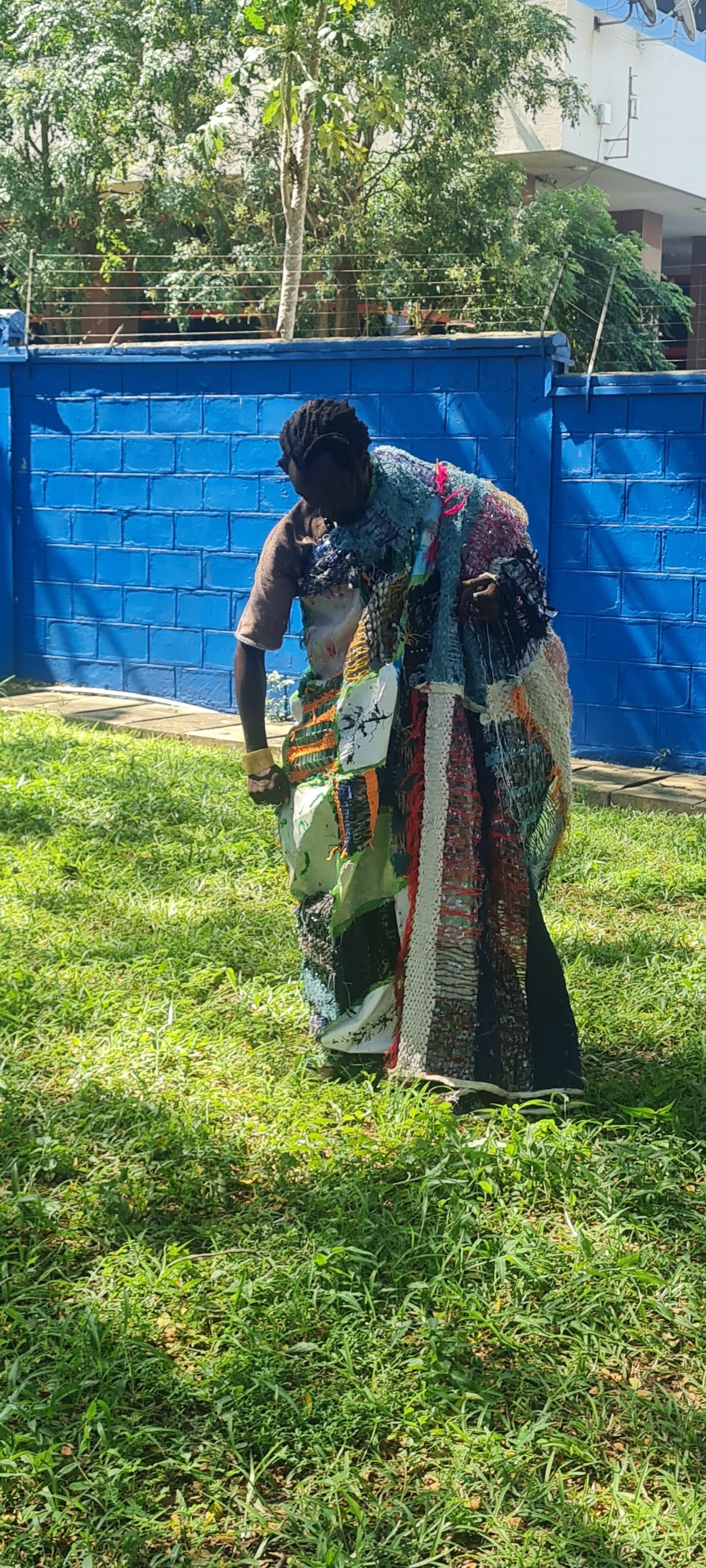
I was born in Adanwomase, in the Ashanti Region of Ghana — a community where the rhythm of the loom is the heartbeat of daily life. I grew up in a household of weavers: my father, my great-grandfather, my kin. We are custodians of Kente, the sacred woven cloth whose name derives from kenten — "basket" — a vessel that holds memory, identity, and spiritual meaning.
To grow up in Adanwomase is to grow up inside a sound. The shuttle flying back and forth across the warp is a kind of breathing. The beat of the treadle is a drum. Before I could name what I was hearing, I understood that the cloth taking shape on my father's loom was not decoration. It was a document. Every colour, every geometry, carried a proverb, a lineage, a warning, a blessing.
Kente is not cloth. It is language. Black speaks of maturation and ancestral spiritual energy; green of vegetation, growth, and renewal; gold of royalty and glory. To weave is to compose meaning from thread — to make visible what is otherwise only felt. This is the epistemology my practice inherits: art is not decoration, it is communication, a vehicle of information transfer and identity construction.
Kente is not cloth. It is language. Each pattern is a proverb, a historical event, a moral teaching, a name.
But my work extends far beyond the loom. It became, over time, an act of remembering, of resistance, and of reimagining what it means to be African in a world that has long told our story for us. For too long, the continent has been perceived through a borrowed lens — filtered through media, flattened by colonial narrative, rendered invisible by neocolonial frameworks. These distortions do not merely shape how the world sees us; they shape how we see ourselves.
Colonialism did not only take our resources; it took our cosmology. It taught us that the earth is an object to be exhausted, that we are merely passing through on the way to some distant heaven, that preservation is irrelevant because this world is not ours to inherit. I reject this. My art is a search for what was lost — and what never left.
When I turned inward, to the language of my ancestors, I discovered that in my mother tongue there is no word for "sustainability." It is an English imposition. But there is Nipadua — the human body, literally "human tree." My ancestors understood the human being as rooted, as leafy, as breathing. This is the backbone of everything I make: the weaver at the loom was never "doing craft." He was singing. He was praying. He was embodying history.
To separate the woven cloth from the body that wove it is to sever the work from its soul. My practice insists on the integrity of the whole — the maker, the making, and the made. The legacy is not the object left behind. The legacy is the gesture, the sound, the memory carried forward by the next pair of hands that sit down at the loom.